


Daily diary
Prompts participants to contribute on a daily basis. Include specific questions or tasks to be completed each day.
Track how behaviour, attitudes, and experiences evolve over time, captured by participants in their own words.
Online diaries give you a structured, time-stamped record of participant experience as it happens. Rather than asking people to recall behaviour at the end of a study, diary tasks capture responses in the moment, building a longitudinal picture of how habits, attitudes, and emotions shift across days, weeks, or months.
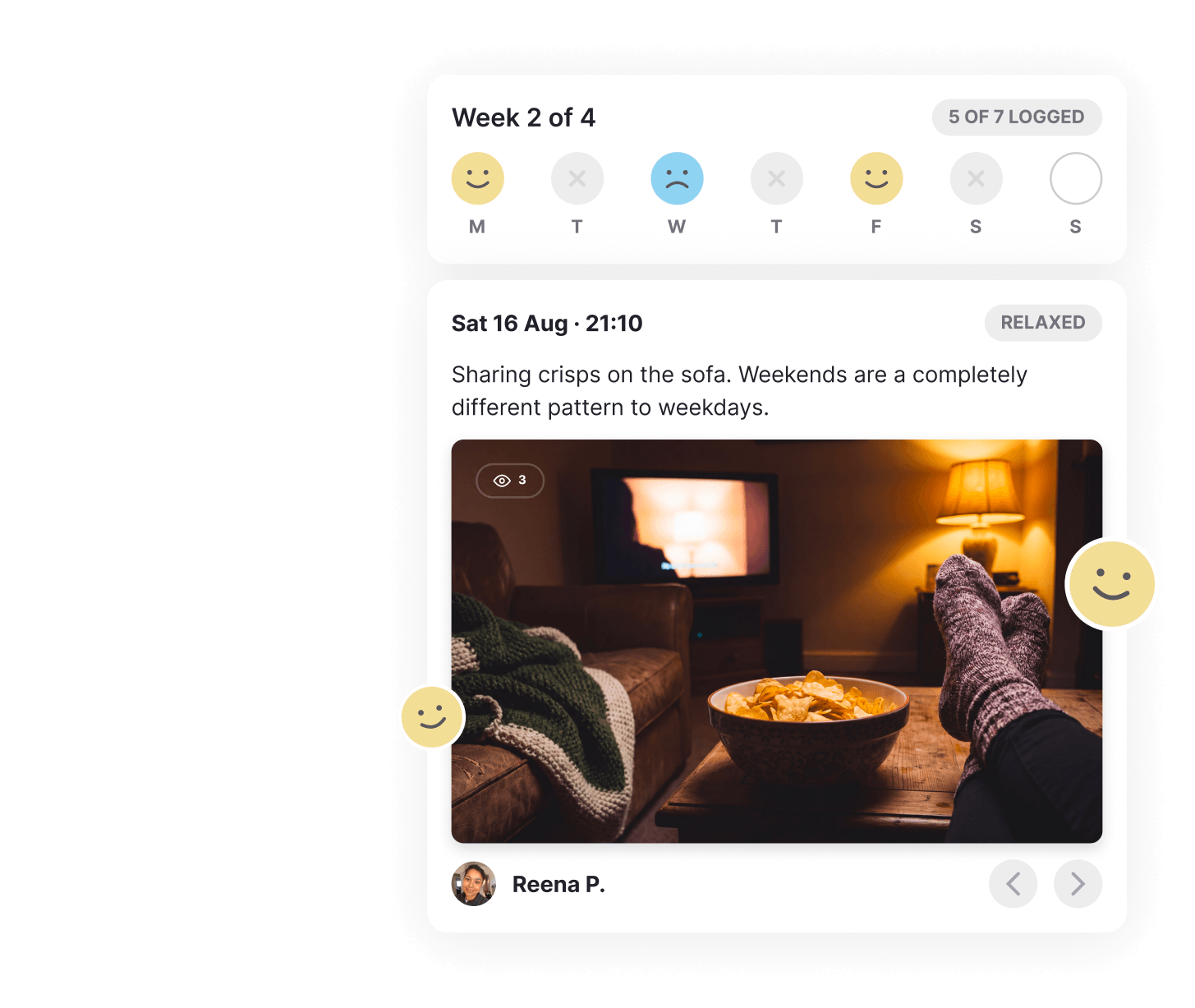
Each diary entry can include text, video, audio, photos, emotion tags, and optional location markers, creating a rich multimedia timeline of participant experience. Three diary formats let you control the cadence and structure of entries to suit your research objectives.
Prompts participants to contribute on a daily basis. Include specific questions or tasks to be completed each day.
Set the number of entries required and allow participants to contribute when it suits them.
Set specific dates or times for entries, with automated reminders sent to participants each time one is due.
Features
All features are included at no additional cost. No restrictions on uploads, entries, or participants.
01
Set questions that participants must answer with each diary entry.
02
Text, video, audio, photos, and screen recordings.
03
Attach any form of media as stimulus.
04
Participants post from mobile, tablet, or laptop.
05
All audio and video content is automatically transcribed.
06
Non-English content is automatically translated.
07
Moderate directly or brief incAI to respond on your behalf.
08
Automatically generated with supporting participant quotes.
Use cases
Diary research fits whenever understanding how something changes over time is more important than capturing a single moment.
Diary research is the right method when you need to understand how behaviour evolves rather than capturing a single moment. Use it to track how a product becomes embedded in a daily routine, how consumption occasions shift across a week, or how attitudes change in response to an event, a season, or a new habit.
Ask participants to record every interaction with a product, brand, or category across a set period. The result is an accurate, contextual picture of when, where, and why usage happens, free from the distortions of recall.
Follow participants through a defined experience, such as a product trial, a new service onboarding, or a healthcare pathway, and capture how their perceptions shift at each stage. The diary format reveals the emotional arc of an experience in a way that end-of-study reflection cannot.
Immerse your team in the day-to-day reality of participants' lives within a category. A week or more of diary entries builds the kind of contextual depth that shapes genuinely distinctive strategy.
Use emotion tags and structured questions across multiple entries to track how sentiment towards a brand, product, or issue shifts over time in response to marketing activity, life events, or market changes.
Ask participants to document their symptoms, daily routines, and interactions with healthcare services over an extended period. The daily format captures the lived reality of managing a condition in a way that retrospective clinical questions cannot.
Keep exploring
Book a demo and see how the diary tool, and the full platform, can work for your next project.


